Published September 12, 2026 in Research
HackTown 2026: how visible are its B2B startups in ChatGPT?
ChatGPT with web search named a HackTown 2026 B2B startup in 2.8% of buyer questions that did not contain its name. Who it cites instead, and what to do.
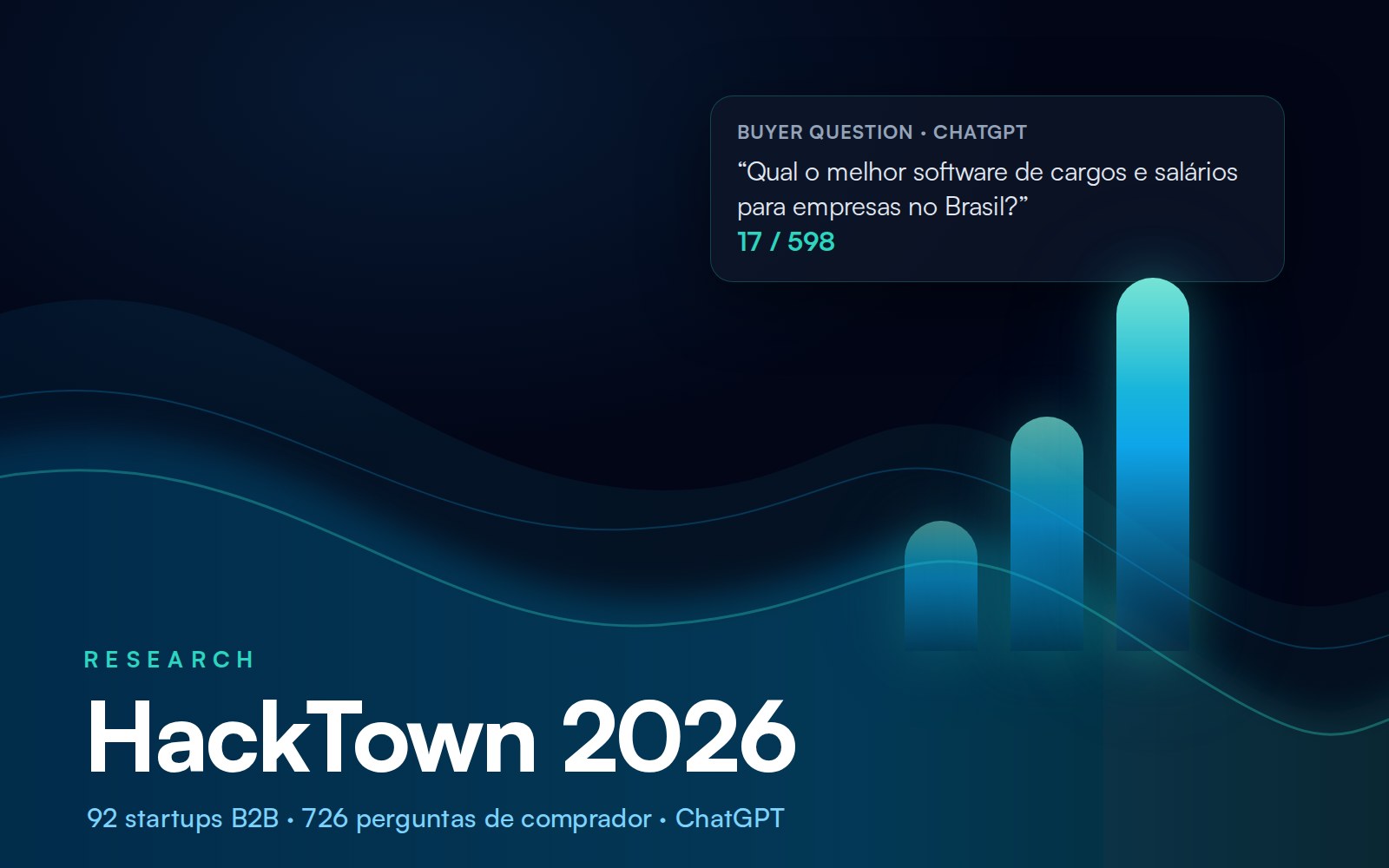
We ran the websites of 92 B2B startups from HackTown 2026 (exhibitors at the Feira de Startups and members of the official startup group) through the Organicus free analysis and asked ChatGPT (web search on) the buyer questions each startup would want to be found by. In the 598 questions that did not contain the brand name, ChatGPT named the startup 17 times (2.8%). Only 13 of the 92 companies (14.1%) were named without being asked about by name.
We (Organicus) had a stand at the Feira de Startups, the startup fair in Santa Rita do Sapucaí, Minas Gerais, on 6 September 2026, and shared each startup's public report with every startup we could reach, before or during the fair. We sell services in this area, so this is first-party data with a first-party interest. One engine, one run, 8 buyer questions per company: a probe, not a census.
How many HackTown 2026 startups show up in ChatGPT?
13 of the 92 startups (14.1%) were named in at least one buyer question that did not contain their name; 23 (25.0%) were never named in any buyer question. At question level: when the question contains the startup's name, ChatGPT names it in 83 of 128 (64.8%); when it does not, in 17 of 598 (2.8%).
That gap is the whole study. "Unaided" means the buyer asks for the best tool, a price or a fix, and the engine has to bring the startup up on its own. Comparison questions like "X vs alternatives" or "is X worth it" hand the name to the engine and measure recall, not discovery, so we report them separately.
| Question type | Questions | Startup named | Rate |
|---|---|---|---|
| All buyer questions (direct + thematic) | 726 | 100 | 13.8% |
| Question contains the brand name | 128 | 83 | 64.8% |
| Unaided (no brand name in the question) | 598 | 17 | 2.8% |
| Unaided, direct ("best…", pricing, problem-solving) | 287 | 16 | 5.6% |
| Unaided, thematic (how-to, business, situation, trend) | 311 | 1 | 0.3% |
| Of the unaided direct: discovery ("which is the best…") | 79 | 8 | 10.1% |
| Of the unaided direct: pricing ("how much does…") | 72 | 3 | 4.2% |
Of the 23 startups never named, 4 had a question carrying their own name and were still not named in it. 56 of 92 (60.9%) were named only when the question named them first. 13 had an unaided mention; 3 had two or more. Across 311 unaided thematic questions, ChatGPT named a HackTown startup once, and that one question named a city. Part of that zero is the answer format, not the startups: only 67 of the 311 unaided thematic answers (21.5%) named any other company, against 178 of 287 direct answers (62.0%).
The slot exists. In 229 of the 598 unaided answers (38.3%), ChatGPT named at least one other company and not the startup; in 181 (30.3%) it named three or more and still left the startup out. For unaided "which is the best…" questions it named other vendors in 78 of 79 answers and the startup in 8. For 86 of the 92 startups, at least one unaided answer listed other companies and left them out.
Does ChatGPT know who these startups are?
Often not. In 54 of the 184 brand questions (29.3%), ChatGPT answered about a different company, product or dictionary meaning that shares the name.
The two brand questions per company ("what is X", "reviews of X") are a control. For 34 of 92 companies (37.0%), at least one answer described someone else; for 20 (21.7%), both did. Short names suffer most: 30 of the 68 companies whose name, as it appears in the brand question, is a single word (44.1%) had a brand question answered about a namesake, against 4 of 24 with a multi-word name (16.7%). Sites in English, whose brand questions were also asked in English, fared worst: 9 of 12. Where ChatGPT found the right company (130 answers), it named it in 114 and cited the company's own site in 96 (73.8%).
The reviews question is its own finding. Of the 62 "reviews of X" answers about the right company, at least 36 said they found few or no independent reviews, and Reclame Aqui, Brazil's consumer-complaints site, came up in 26, usually to report that the company had no profile there. Where it looked: the company's own site (44 of the 62 answers), LinkedIn pages (24), company registries such as Serasa and Econodata (17), Reclame Aqui (15), Glassdoor (8), Capterra (3) and G2 (2).
Being known and being recommended turned out to be separate things. Of the 47 companies ChatGPT identified and named on both brand questions, 7 got an unaided mention; of the 20 whose brand questions both went to a namesake, 3 did. The reverse also holds: 17 of those 20 still appeared in at least one buyer answer, 16 of them on a question that spelled out their name and their category (19 of their 24 such questions). A name alone was ambiguous; name plus category was not.
Who does ChatGPT cite and recommend instead?
Governments, big-tech documentation and consultancies. Among the third of citations we could classify (877 of 2,526), 7 in 10 point at government, big-tech documentation or global consultancies (628 of 877); the other two thirds are a long tail of hosts, almost all cited once or twice.
639 of 726 buyer answers (88.0%) cited at least one web source: 2,526 answer-and-host pairs across 1,439 distinct hosts, 1,084 of them cited exactly once. We hand-classified the 120 most-cited hosts across the whole study; 112 of them appear in the B2B answers.
| Source type | Pairs | Share of classified |
|---|---|---|
| Government or regulator (gov.br, Planalto, Banco Central, NIST, WHO) | 360 | 41.0% |
| Big-tech vendor documentation (Microsoft, AWS, Google, IBM) | 176 | 20.1% |
| Global consultancy or analyst (McKinsey, Deloitte, Accenture) | 92 | 10.5% |
| International software vendor (HubSpot, Twilio, Genesys) | 75 | 8.6% |
| Academic or standards body (ISO, OWASP, arXiv) | 75 | 8.6% |
| Brazilian vendor or startup (Gupy, Omie, iClinic; 6 pairs are sample startups' own domains) | 44 | 5.0% |
| LinkedIn pages, app stores or directories (LinkedIn 20, app stores 6, Clutch 5) | 33 | 3.8% |
| NGO or association (Sebrae, SHRM, World Economic Forum) | 21 | 2.4% |
| Social or community | 1 | 0.1% |
gov.br alone was cited in 133 buyer answers; nist.gov, the US standards agency, in 40; Planalto, where Brazilian federal law is published, in 30. 259 of 726 answers (35.7%) cited at least one host on a .gov or .gov.br domain. The 92 startups' own websites, all together, were cited in 80 buyer answers (16 unaided, 64 when the question named the brand): fewer than gov.br alone. 54 of the 92 companies had gov.br cited in at least one of their own buyer answers, and no buyer answer cited another startup from the cohort. Reddit did not appear once; review platforms appeared in 8 of the 2,526 pairs (Clutch 5, Reclame Aqui 2, G2 1).
ChatGPT also recommends by name: 326 of 726 answers (44.9%) named at least one other company, and the names that recur are global: Accenture in 12 answers, HubSpot 11, Deloitte 11, Stefanini 9, CI&T 9, Thoughtworks 7. For HR software questions it reached for Gupy, Sólides and Recrutei; for clinic management, iClinic and Feegow. Category observations, not verdicts on any startup.
What do the startups' websites have in common?
They are small. The crawler read a median of 10 pages per site; 34 of the 89 readable sites (38.2%) had 5 pages or fewer, 18 (20.2%) were a single page, 11 had 100 or more, and 51 (57.3%) had a sitemap. Those small counts are not a truncated crawl: on all 34 sites with 5 pages or fewer the crawler also discovered 5 internal URLs or fewer, and only 3 sites in the sample hit the 300-page ceiling.
The crawler read 89 of 92 sites; 3 returned zero pages (DNS or TLS problems on the apex domain, or a CDN blocking automated access) and stay in the visibility numbers only. The mean Organicus Score, our 0 to 100 composite of AI visibility, LLM understanding, content, technical health and structure, was 52.1 across readable sites (median 52, range 29 to 74); 22 of 89 scored 60 or more, 5 scored 70 or more, none reached a B, which starts at 75. The highest score among the 92, 74, came from a 2-page HR-tech site (Thalora).
| Finding | Sites | Share |
|---|---|---|
| No About or Company page anywhere on the site | 56 | 62.9% |
| No Organization schema on the homepage | 54 | 60.7% |
| No structured data of any kind on the homepage | 49 | 55.1% |
| No canonical tag on at least one page | 60 | 67.4% |
| Missing meta description on at least one page | 29 | 32.6% |
| No robots.txt | 27 | 30.3% |
| At least one AI crawler fully blocked in robots.txt (own or CDN-managed) | 12 | 13.5% |
40 of 89 sites lack both an About page and Organization schema; 19 have both. Across the seven checks, the median site fails 4; four sites pass all seven, among them the event platform 4.events.
What separates the mentioned from the invisible?
A specific question and a site ChatGPT could read and cite, not the on-page checklist. With 17 unaided mentions across 13 companies, nothing here is proven, so read the patterns as indicative.
They may also be noise. If every one of the 598 unaided questions had the same 2.8% chance of a mention, we would expect about 76 companies with none, 14 with one and 1 or 2 with two or more; we saw 79, 10 and 3, which is within chance (about 14% probability).
The score leans, but does not decide. Companies with an unaided mention averaged 57.5 on the Organicus Score against 51.2 for the rest (medians 60 and 50), and their scores ran from 39 to 73. 7 of the 22 sites scoring 60 or more had an unaided mention; 2 of the 39 under 50 did. The correlation between score and unaided mentions across the 89 readable sites is 0.22, on a scale where 0 is no relationship and 1 is lockstep, and part of that is circular, because a quarter of the score is computed from these same answers; on the on-page engines alone it is 0.14 (computed from the per-company data).
The on-page basics did not separate them. An About page: 5 of the 33 sites with one had an unaided mention, against 8 of the 56 without. Organization schema: 6 of 35 against 7 of 54. Size did not decide either: 6 of the 34 sites with 5 pages or fewer were named unaided, against 1 of the 11 sites with 100 pages or more. Of the 12 sites that block an AI crawler, 1 was named unaided. Sector did not separate them either: the 13 companies carry 11 different HackTown sector labels.
Being cited came with being named. In 16 of the 17 unaided mentions the company's own domain was among the answer's sources (the one exception cited that startup's separate product domain). Across the 45 questions that contained the brand name and still did not get it mentioned, the own site was cited zero times.
Specific questions produced the mentions. 8 of the 17 came from "which is the best…" questions with a precise category, and 4 of the 6 unaided questions that named a city or state produced a mention (two companies, one of them three times). When the startup was named, it was usually a recommendation, not a footnote: 7 of the 17 put it first with a strong recommendation. Three examples, none of them a client:
- Deppes (deppes.com.br), HR software for job and salary structures: named in 2 of 7 unaided questions, first for "best job-and-salary software with performance reviews for companies in Brazil". 38 pages read, score 72.
- Teztor (teztor.com.br), a free whistleblowing channel for companies: first for "best free reporting channel for companies in Brazil". 33 pages, score 73.
- 20Entregar (20entregar.com.br), a delivery and rides platform whose buyer questions named its city, Itajubá: named in 3 of 7 unaided questions, including the study's only thematic mention. 15 pages, score 65.
What they share is a question specific enough, a precise category or a city, that the engine went looking, and a site it could read and cite once it looked. What they do not share is a checklist: none of the three passes every check in the table above.
How we measured
Sample. The official HackTown 2026 "startups confirmadas" list (115 unique startups, 94 with a live website for a web-discovered business), plus 25 companies present in the official HackTown Startups 2026 WhatsApp group, plus 3 met at our stand. Excluded: no website, offline, not discovered through the web, six sites that are not startups, and one startup's separate product domain, to avoid double counting. Of 116 startups analyzed, 92 sell to businesses (B2B, B2B2C or B2G), classified by two independent LLM passes with a third as tiebreak on the 4 disagreements: this article's sample. 80 sites are in Portuguese, 12 in English.
Crawl. Headless Chromium via Playwright, JavaScript rendered, up to 300 pages per site from the homepage, internal links and sitemap, once per site between 3 and 6 September 2026. A manual QA of 241 findings on 3 September found 43 false (18%), concentrated in the entity-definition, FAQ-detection and statistics checkers; those were fixed on 4 September, and the blog checker was corrected mid-batch too. Reports run before a fix keep their findings, so this article uses only the deterministic checks in the table above.
Questions. 10 per company, generated by an LLM from the site's own homepage title, description, H1 and key pages plus its detected industry, in the site's language, for the Brazilian market: 2 brand questions, 4 direct (drawn from discovery, comparison, problem-solving, research and pricing) and 4 thematic (drawn from how-to, business, situation, lifestyle and trend). 82 companies got 8 buyer questions and 10 got 7, when one generated question named a foreign market and was dropped. Unaided questions per company ranged from 0 to 8 (median 7); one company had none, because all 8 of its buyer questions named it.
Engine. ChatGPT through OpenAI's API with the web-search tool on, user location Brazil, the fast GPT-5.6 tier current at the time. One run, one answer per question. Grounded answers are not repeatable: asked twice, the same question can cite different sources.
What counts. "Named": an extraction pass found the brand in the answer text (position, recommendation strength, sentiment and competitors are extracted the same way). "Own site cited": the company's domain is among the answer's sources. "Answered about another entity": the extraction pass judged that the answer described a different company or meaning with a similar name; we re-read the flagged answers and corrected one company whose two answers described the company itself. "Unaided": the question does not contain the brand name, matched on name, domain label and name tokens, hand-checked for short names. Organicus Score weights: AI Visibility 25%, LLM Understanding 25%, Content Quality 20%, Technical Health 20%, Structure 10%; unreadable sites are excluded from score statistics.
What this study cannot tell you
One engine: Claude, Gemini, Perplexity and Google AI Mode were not tested, and engines differ in what they cite. Eight buyer questions per company is a probe, and wording drives results. One run on one day. The questions come from the site's own framing, so a site that describes itself badly got questions about the wrong category; we saw this in a handful of sites. The sample is self-selected, early-stage and regional, not representative of Brazilian B2B. Nothing here is causal: the mentioned companies differ from the rest in ways we did not measure. Our rules for what we claim are in the evidence-first methodology.
What can a founder do with this?
Observations turned into work items. No timelines and no guarantees: positions in AI answers are not something we, or anyone, control.
1. Check whether the engine can identify you. 34 of 92 companies had at least one brand question answered about someone else. Ask "what is [your company]" in a temporary chat. If someone else comes back, the work is consistency, not volume: the same name and one-sentence description on your site, LinkedIn, app stores and company registry, and an About page (56 of 89 had none; sites with one had a brand question answered about a namesake for 9 of 33 companies, against 24 of 56 without). Add Organization schema with sameAs links as hygiene (54 had none): in this sample its presence made no visible difference, 13 of 35 against 20 of 54.
2. Confirm a bot can read your site. 3 of 92 sites returned zero pages and 12 of 89 block at least one AI crawler. Request your homepage with the GPTBot or OAI-SearchBot user agent and look at what the server returns, not what your browser shows. If you sit behind a CDN, read its bot settings rather than assuming: in 8 of the 12 blocked sites the block came from the CDN's managed robots.txt. Note what the block covers: where our report recorded the list, that managed block named GPTBot, ClaudeBot and training crawlers, not OAI-SearchBot, the crawler ChatGPT's web search uses, which is why a blocked site could still be named in this study. Check the search crawler by name, not the toggle.
3. Write the one sentence, then the page. Put a plain "X is a Y for Z" in the first block of the homepage. Then build the page that matches the question type that produced the mentions here: one that names your category and market precisely, the way the "which is the best…" questions did (8 mentions in 79). Pricing questions were asked 72 times and produced 3 mentions, close to the study's baseline rate, so a public pricing page is hygiene for the buyer, not a lever in this data. Thematic content (how-to, business, situation, trend) produced 1 mention in 311 questions, and that one was about a city; write it for people, not for the engine.
4. Get named in places you do not own. Our data shows where ChatGPT reads: government and big-tech documentation you cannot enter, but also vendor ecosystems, directories and Brazilian vendors you can. Ahrefs' correlation studies of about 75,000 brands (May and December 2025) found that mentions on other people's pages track AI visibility far more closely than backlinks or domain rating, and its authors say themselves that correlation is not causation. A partner's integrations page, an association listing, a podcast transcript, a comparison written by someone else.
5. Measure with buyer questions, and repeat. "I asked ChatGPT and we were not there" is one roll of the dice. Take three questions your buyer actually asks, run each five times in a temporary chat, and keep the fraction. The gap between your brand question and your buyer question is the number to work on.
In 598 buyer questions that did not contain the brand name, ChatGPT named the HackTown startup 17 times. It cited gov.br in 112 of them.